

 Facebook
 X
X
 Pinterest
 Copy Link
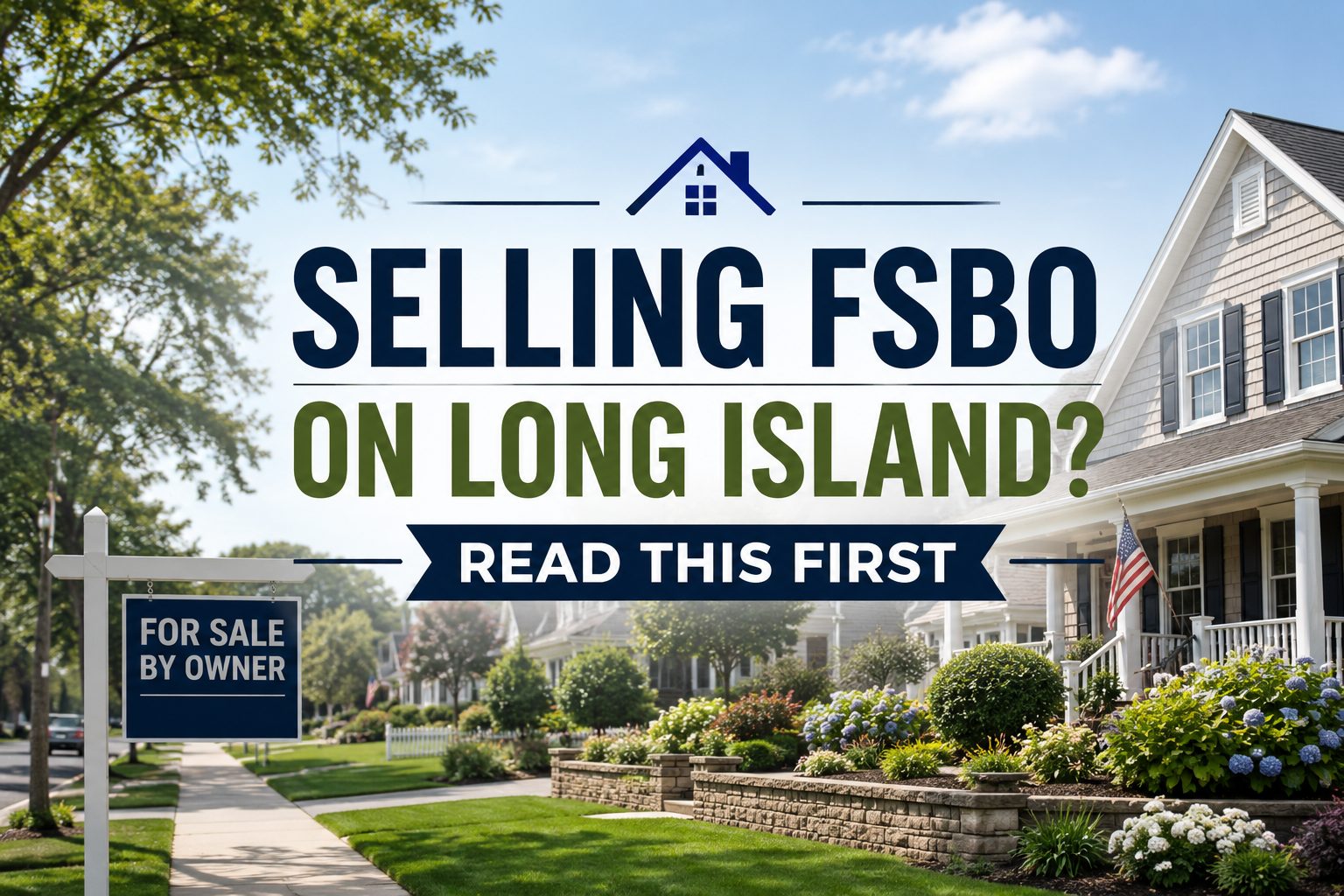
Every year, a meaningful number of homeowners in New York attempt to sell their homes without a real estate agent. The motivation is almost always the same: avoid paying the commission. It seems logical on the surface – why share 5% to 6% of your sale price when you could pocket that money yourself?
The problem is that this calculation, as most sellers do it, is incomplete. It focuses on the cost of the agent without accounting for the value the agent provides – and the real-world data on what happens when sellers go it alone is considerably less flattering to the FSBO approach than most people expect.
What FSBO Sellers Actually Save
Let's start with what FSBO sellers genuinely save. If you sell without a listing agent, you avoid paying the listing agent's portion of the commission – which is typically 2.5% to 3% of the sale price. On a $650,000 home, that's $16,250 to $19,500.
However, if the buyer is represented by a buyer's agent – which the overwhelming majority of buyers are – you will still typically need to offer compensation to the buyer's agent to get buyer's agents to show your property. This is often 2.5% to 3% of the sale price as well. So on a $650,000 sale, you might save roughly $16,000 to $19,000 in listing agent commission – but you still pay $16,000 to $19,000 to the buyer's agent. Your true gross savings from going FSBO is often only the listing agent's side of the commission.
In New York, where agent commissions have traditionally been structured as 5-6% split between both sides, the FSBO seller's true saving is approximately half of that – not the full commission.
What FSBO Sellers Typically Lose
The National Association of Realtors tracks median sale prices for agent-assisted sales versus FSBO sales, and the findings are consistently striking. Agent-assisted homes sell for significantly more than FSBO homes – the gap in recent years has been 15% to 20% in favor of agent-assisted sales nationally.
The reasons for this gap are multiple and reinforcing. FSBO sellers don't have access to the full MLS (the most powerful buyer-facing distribution tool available), which limits the pool of buyers who see the listing. Fewer buyers means less competition. Less competition means lower offers and less leverage in negotiation. Additionally, FSBO sellers typically lack the pricing expertise, marketing resources, negotiating experience, and transaction management capabilities that experienced agents bring – all of which affect the final sale price and the smoothness of the transaction.
In New York specifically, where the complexity of transactions is high (attorney requirements, co-op board approvals, complex disclosure requirements, and the nuances of a market with enormous variability by neighborhood), the risks of going unrepresented are particularly pronounced.
The Time and Stress Equation
What FSBO calculations also rarely account for is the time and stress involved in managing a home sale without professional support.
A seller going FSBO is responsible for: answering inquiries and scheduling showings, screening buyers to verify they're qualified before spending time on them, preparing all marketing materials, negotiating directly with buyers and their agents (who do this professionally every day), coordinating the inspection process, managing contract timelines, and navigating the closing process without the benefit of someone who has done it hundreds of times.
For most sellers, this represents dozens of hours of work over several weeks or months, during a period when they're simultaneously trying to live their regular life and prepare for a move.
When FSBO Sometimes Makes Sense
There are situations where selling without a traditional listing agent is more reasonable. If you already have a buyer – a family member, a neighbor who has expressed interest, a colleague who wants to buy your specific home – going without a listing agent makes more sense, because the primary value an agent adds in generating buyer interest is not needed.
In this scenario, you still need a real estate attorney (mandatory in New York), you still need to understand the disclosure requirements, and you still need to negotiate and manage the transaction competently. But the marketing function is unnecessary when you have an identified buyer.
If you're selling to a cash investor or through a specific off-market channel where the buyer is pre-identified, the calculus is different. For open market sales to the general public, the evidence that agent-assisted sales produce better net outcomes is compelling.
The Honest Question to Ask
The question isn't "how do I avoid paying a commission?" The question is "how do I maximize my net proceeds?" These are different questions with potentially different answers.
A listing agent who charges a 3% commission on the listing side but sells your home for 8% to 10% more than you would have gotten on your own has made you significantly more money than you would have walking away from the commission entirely. The commission is a cost. The sale price is the revenue. What matters is the net.
I'm happy to have this conversation honestly with any seller who's considering their options. If you want to know specifically what I can do for your home – the pricing analysis, the marketing plan, the negotiation approach – and how that compares to going it alone, I welcome that comparison. Call me at (321) 447-4259 or visit movewithricky.com.
Rakesh (Ricky) Khanna | Licensed Real Estate Salesperson
Better Homes and Gardens Real Estate Realty Connect
Call or text: (321) 447-4259 | movewithricky.com
 |
 |
 |
 |
 |


